Our “New Research” series provides the public with a venue to read the most recently published RAC research reports. These reports have been prepared by RAC travel stipends recipients who come to our reading room to study the archival materials that we preserve and make available to researchers from around the world. Showcasing the wide range of collections that they have used, researchers’ interests include topics from many historical periods and disciplines, and approach the records with different perspectives in mind. This edition’s set of reports cites records from the General Education Board, the Rockefeller Foundation, and the Office of the Messrs. Rockefeller. The reports also make use of the personal papers of Kenneth C. Smithburn, Robert H. Kokernot, Abby Aldrich Rockefeller, Nelson A. Rockefeller, and John D. Rockefeller, Jr.
“Schooling the Mountains: The General Education Board’s Work in Progressive Era Southern Appalachia” by Allen Fletcher
In his report, “Schooling the Mountains: The General Education Board’s Work in Progressive Era Southern Appalachia,” Allen Fletcher seeks to broaden the narrative about education reform in Southern Appalachia. As he observes, this region “had developed a reputation within American consciousness for lawlessness, violence, and general backwardness.” Yet, this perception focused almost exclusively on the “Anglo stock” of the residents while completely bypassing the African American communities throughout this area. His research seeks to redress this view, as he came to RAC to better understand the impact of the philanthropic activities of the General Education Board (GEB) in Appalachia. Created in the first years of the twentieth century by John D. Rockefeller, Sr. to support education in the United States “without distinction of race, sex, or creed,” it aided Black education throughout the South. In this context, the researcher studied the work of the Jeanes teachers in Southern Appalachia, who were partially funded by the GEB. These Black supervisors had to navigate an educational terrain with deeply embedded racism and limited resources. He noted that Southern Appalachia’s Black communities prioritized schools as centers not only for education, but for racial and community uplift. In this regard, GEB’s funds ultimately helped prepare the groundwork for later community grassroots-based school reform.
Allen Fletcher is a doctoral candidate at the University of Kentucky. His research interests center on the history of Appalachia and Kentucky, and he is an associate editor of the Register of the Kentucky Historical Society. He was a 2024 RAC research stipend recipient.
“The Rockefeller Foundation and the Transregional Production of Quarantine Knowledge: Space, Race, and Responsibilization between the US and South Africa” by Laura-Elena Keck
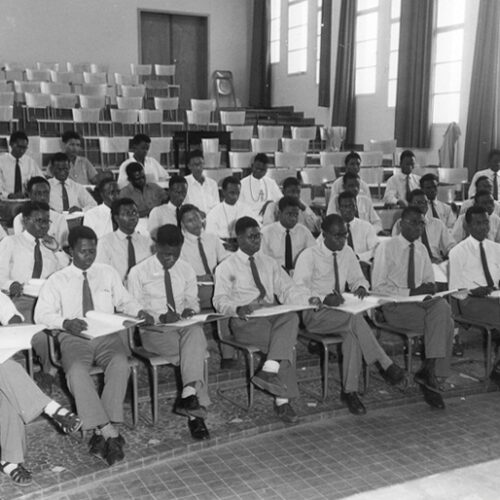
Laura-Elena Keck points out that the Rockefeller Foundation (RF) has been a global actor in public health since early in the twentieth century. As part of its activities, the RF has served as a transnational conduit for medical knowledge and expertise. In her research report, “The Rockefeller Foundation and the Transregional Production of Quarantine Knowledge: Space, Race, and Responsibilization between the US and South Africa,” she looks at a particular chapter in this role – its involvement with infectious disease research in South Africa, with a special emphasis on the Apartheid era. Her exploration of the RF archives at RAC was an opportunity to contextualize its work there on arbovirus research and social medicine initiatives in the production of broader transnational knowledge about quarantine, an age-old tool (that was recently used globally during the COVID-19 pandemic) to manage public health. Studying the RF records on its engagement with South Africa during Apartheid provides important insight not only on the impact of the racial system on health care, but also on how the Foundation navigated this difficult terrain when dealing with those policies. Laura-Elena Keck concludes her report by noting that her time at RAC has assisted her in developing her thinking about quarantine knowledge production, networks of medical knowledge, and the role of Apartheid, race, and segregation on the process.
Laura-Elena Keck is the research coordinator at the Max Planck Institute for the History of Science in Berlin. She holds a Ph.D. in history from the University of Leipzig. Her research interests include transnational knowledge production and networks. She was a 2023 RAC research stipend recipient.
“Abby Aldrich Rockefeller and American Modernism at MoMA” by Eliza Butler
In “Abby Aldrich Rockefeller and American Modernism at MoMA,” Eliza Butler surveys Abby Aldrich Rockefeller’s (AAR) central role in founding and shaping the Museum of Modern Art in New York. The researcher argues that early-on, AAR defined the museum’s understanding of modernism, specifically American modernism. Following her research at RAC, Eliza Butler is able to offer an alternative to the critique that MoMA was an institution dominated by white men, both in terms of the trustees and the painters whose works were exhibited on its walls. Instead, she argues that a woman quietly ran MoMA in its early years and tried to exert an inclusive agenda. In her New York City home’s Topside Gallery, Abby Aldrich Rockefeller included the works of many women, artists of color, and non-Christians. Thus, by its very nature, her major 1935 gift from her personal collection broadened the museum’s holdings and helped shape a new vision of the parameters of modern art.
Eliza Butler is an independent art historian who has been a core lecturer in art history at Columbia University, where she had also received her Ph.D. Her research interests focus on inclusive art collecting and modernism at art museums. She was a 2024 RAC research stipend recipient.
“The Millionaire’s Son: Newspaper and Scrapbook Portraits of John D. Rockefeller, Jr. in College“ by Jiemin Tina Wei
Jiemin Tina Wei’s research in RAC’s reading room gave her an opportunity to explore John D. Rockefeller, Jr.’s (JDR, Jr.) scrapbooks. Scrapbook collections can vary greatly in form and content, and while being a medium for creative expression and sentimentality, some of them hold little historical research value. For this researcher, that was certainly not the case with JDR, Jr.’s scrapbooks. His undergraduate college-era scrapbooks provided an important window into how print journalism viewed his character, his relationship with his family, as well as perceptions about the impact of early Rockefeller philanthropy on the academic world. She found the newspaper coverage was overwhelmingly positive. Yet, there was also steady thread criticizing the role of Rockefeller philanthropy in shaping both the institutions that it funded and those that it passed over. The researcher notes that the themes appearing in these scrapbook clippings thus presage a long history of subsequent critiques of Rockefeller wealth and philanthropy.
Jiemin Tina Wei is a Ph.D. candidate in Harvard University’s Department of the History of Science. She is writing her dissertation on the history of fatigue in the workplace in the early-twentieth century US. She was a 2023 RAC research stipend recipient.
About the RAC Research Stipend Program
The Rockefeller Archive Center offers a competitive research stipend program that provides individuals up to $5,000 for reimbursement of travel and accommodation expenses. Learn more on our Research Stipend page.