This is the latest edition of our “New Research” series, which provides the public with an opportunity to read the most recently published Rockefeller Archive Center Research Reports. These reports have been prepared by RAC research stipend recipients who have come to our reading room to study the archival materials that we preserve and make available to users from around the world. The reports showcase the wide range of collections that researchers have used, and often highlight philanthropy’s local and gloabl impact. Indeed, the reports presented in this edition are set in four different continents. They reflect researchers’ study of records from the Rockefeller Foundation, the Ford Foundation, and the China Medical Board. Also cited are the Rodman C. Rockefeller papers.
“Transatlantic Crossings for Experts’ Training: Italian Agricultural Economics’ Round-trip from Naples to the United States” by Mario De Prospo
In his report, “Transatlantic Crossings for Experts’ Training: Italian Agricultural Economics’ Round-trip from Naples to the United States,” Mario De Prospo looks at the development of early Cold War-era transatlantic knowledge networks. He traces the career path of economist Manlio Rossi-Doria to highlight how these activities not only fostered academic exchanges, but concretely impacted efforts to improve rural development in southern Italy. Two major US foundations of the era, the Rockefeller Foundation (RF), and then the Ford Foundation (FF), were involved in different aspects of these endeavors that extended from the early 1950s to the mid-1960s. Their interests in the social sciences, higher education, and agricultural development saw this economically lagging region of Italy as a laboratory for philanthropic initiatives to improve conditions. In the RF records at RAC, Prof. De Prospo looked at the fellowship support for Rossi-Doria’s time at University of California Berkeley where Rossi-Doria proposed the idea of creating an academic exchange that would lead to the establishment of a graduate studies program at an academic institution in Naples. While this idea was not picked up by the Rockefeller Foundation, the Ford Foundation saw it differently. The idea fit into Ford’s broader commitment to supporting advanced training in agrarian economics for the whole Mediterranean region. Thus, starting in 1959, it provided a series of grants for a joint initiative between the University of Naples and UC Berkeley to establish in Naples a center for research and advanced training in that field, aimed for students and academics in southern Europe and North Africa. As Mario De Prospo reviewed the Ford Foundation grant records and catalogued reports, he noted that this initiative had a broader impact on Italy, as it nurtured its graduate education program overall, and also strengthened its ties to the United States.
Mario De Prospo is an assistant professor in contemporary history at the Dipartimento di Scienze Politiche e Sociali of the Università degli Studi di Pavia. His research interests focus primarily on the history and agency of 20th-century ruling classes, particularly the relationships between technical and intellectual elites and policymakers. He was a 2024 RAC research stipend recipient.
“‘This is a Revolutionary Beginning’: Rodman Rockefeller, Miguel de la Madrid, and Bilateral Relations for US-Mexico Free Trade, 1981-85” by Jordan Buchanan
Jordan Buchanan’s research report, “‘This is a Revolutionary Beginning’: Rodman Rockefeller, Miguel de la Madrid, and Bilateral Relations for US-Mexico Free Trade, 1981-85,” is a study of the role of the US-Mexico Business Committee in encouraging Mexico’s decision to join the General Agreement on Tariffs and Trade (GATT) in 1985. At RAC, he conducted research in the papers of Rodman C. Rockefeller, who was the chairman of the committee. Rodman Rockefeller was a strong believer in the benefit of free trade and used his influence and connections to encourage this policy decision by the administration of Mexican President Miguel de la Madrid. Buchanan notes that these developments reflected a new approach to US-Latin American relations, resulting from the election of Ronald Reagan in 1980. The Reagan administration placed heavy emphasis on bilateral relations, in which US business interests and their Latin American counterparts were strong advocates of lifting trade barriers. In this context, Rodman Rockefeller’s advocacy for Mexico’s joining of GATT was a persuasive component for that country’s reorientation of its trade policy.
Jordan Buchanan is studying for his Ph.D. in history at the University of California, San Diego. His doctoral research looks at Mexican urban housing policies and the impact of neoliberalism on society. He was a 2024 RAC research stipend recipient.
“A Historical Review of George Y. Char, the Pioneer of Urology in Modern China (1887-1951)” by Cheng Zhen
Professor Cheng Zhen came to RAC from China with a goal of gaining a deeper understanding of Dr. George Y. Char, who is considered a central figure for the development of modern urology in China. In her report, “A Historical Review of George Y. Char, the Pioneer of Urology in Modern China (1887-1951),” she fills in many of the gaps in the historical record about his personal and professional biography. By exploring the records of the China Medical Board, a Rockefeller-founded philanthropy established in 1914, the researcher traces the three separate fellowships that Dr. Char received. Char’s extensive training and travel highlight the transnational impact of this support. Prof. Zhen’s studies shed light on how the Hawaii-born physician’s experiences in China and abroad helped transform the educational theory, surgical practice and medical care in the genito-urinary field in China.
Cheng Zhen is a professor in the Department of History of Medicine, Peking University Health Science Center. Her research interests include history of medicine in China, comparative history of Chinese and Western medicine, and historical research on women and medicine. Professor Zhen was a 2024 RAC research stipend recipient.
“‘At Lord Lugard’s Table’: The Ford Foundation and the Making of Modernization Theory in Late Colonial Africa” by Simon Werner
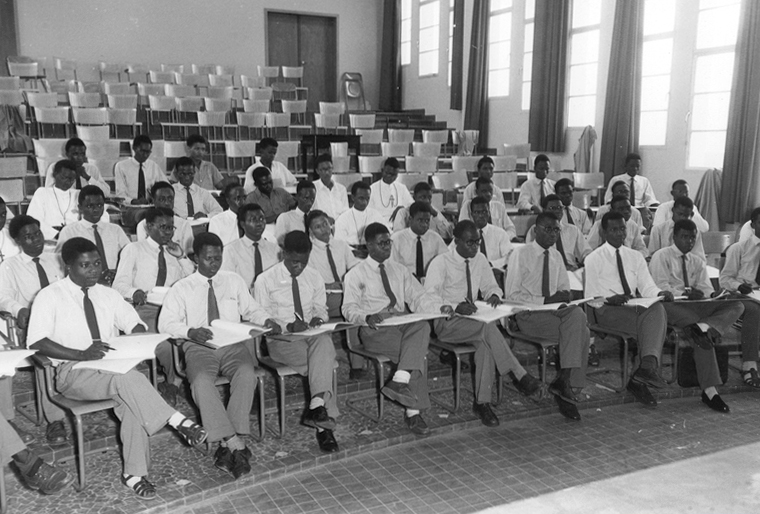
In the 1950s, the Ford Foundation was a “newcomer” to the field of social science research on Africa, whereas other foundations, such as the Rockefeller Foundation and the Carnegie Corporation, already had long histories of engagement with the continent. In his report, “‘At Lord Lugard’s Table’: The Ford Foundation and the Making of Modernization Theory in Late Colonial Africa,” Simon Werner looks at both how Ford approached the field and how it subsequently helped shape the research paradigm for African studies. He notes that during this new Cold War era, Africa was on the periphery of the burgeoning field of area studies, which had focused primarily on various European countries, as well as South and East Asia. At the time, social science research on Africa was in the shadow of late colonial rule and was dominated by European anthropologists. The Ford Foundation’s new interest in the continent occurred at the very time that Africa was starting to undergo processes to free itself from colonial rule. During the 1950s, the Ford Foundation still had to navigate through colonial administrations and colonial-dominated institutions. Yet, Werner’s study of the records reveals important documentation on how Ford saw fresh opportunities to begin reorienting social science research on Africa in light of the political changes occurring, especially towards questions of modernization theory.
Simon Werner is a researcher in the Department of History of the European University Institute. His research interests center on the history of social sciences, with a particular interest in its development in the African context. He was a 2024 RAC research stipend recipient.
About the RAC Research Stipend Program
The Rockefeller Archive Center offers a competitive research stipend program that provides individuals up to $5,000 for reimbursement of travel and accommodation expenses. Learn more on our Research Stipend page.