Primary Source Workshop: 9–12 or Undergraduate/Graduate
How To Use This Primary Source Workshop
Since the atomic bombings of Hiroshima and Nagasaki there have been ongoing historical debates and moral discussions around the use of the bomb during the war and the potential for use again moving forward.
This workshop will look at the ongoing discussions and debates through the lens of the leadership of the Rockefeller Foundation at the time of the development and use of the atomic bomb. More specifically, the workshop will ask students to make arguments for and against the Foundation providing funding for the work that contributed to the development of the atomic bomb. Taking into account the date span in which the primary sources were created, and the internal discussions that were taking place in the Foundation, students will analyze the documents and debate the following question:
Would you as a foundation leader provide the funding that contributed to the development of the atomic bomb?
In small and whole group settings, the students will debate their decisions and articulate why funding should or should not have been provided.
This workshop will support primary source literacy skill development, and students are encouraged to use this experience as a springboard for further research into the role foundations played during World War II and, more broadly, learn about nonprofits impact on foreign policy.
This workshop was developed for Victoria Phillips’ CUNY Graduate Center course, Soldiers, Scientists, Diplomats and Spies: Telling the Cold War through Biography and Memoir, in the spring 2025 semester.
Historical Context
Adapted from RE:source story, The Rockefeller Foundation’s Role in Creating the Atomic Bomb
The Rockefeller Foundation
In 1913, New York State incorporated what would soon become the largest philanthropic organization in the world: the Rockefeller Foundation (RF). The brainchild of John D. Rockefeller, Sr., his son, John D. Rockefeller, Jr., and his advisor, Frederick Gates, the RF was one of the first foundations to practice organized institutional giving and had an exceptionally broad mission: “to promote the well- being of mankind throughout the world.”
Beginning around 1917, the RF supported scientific research in the physical, medical, and natural sciences, especially in Europe and the United States. By the 1930s, the Foundation had added the social sciences to its slate of concerns. Following a major internal reorganization, the RF adopted the core strategy of promoting “the advancement of knowledge.” This approach viewed intellectual discovery and exchange as the primary lever for improving “the well-being of mankind,” reasoning that new knowledge would inevitably lead to human progress.
The Atomic Bomb and the RF
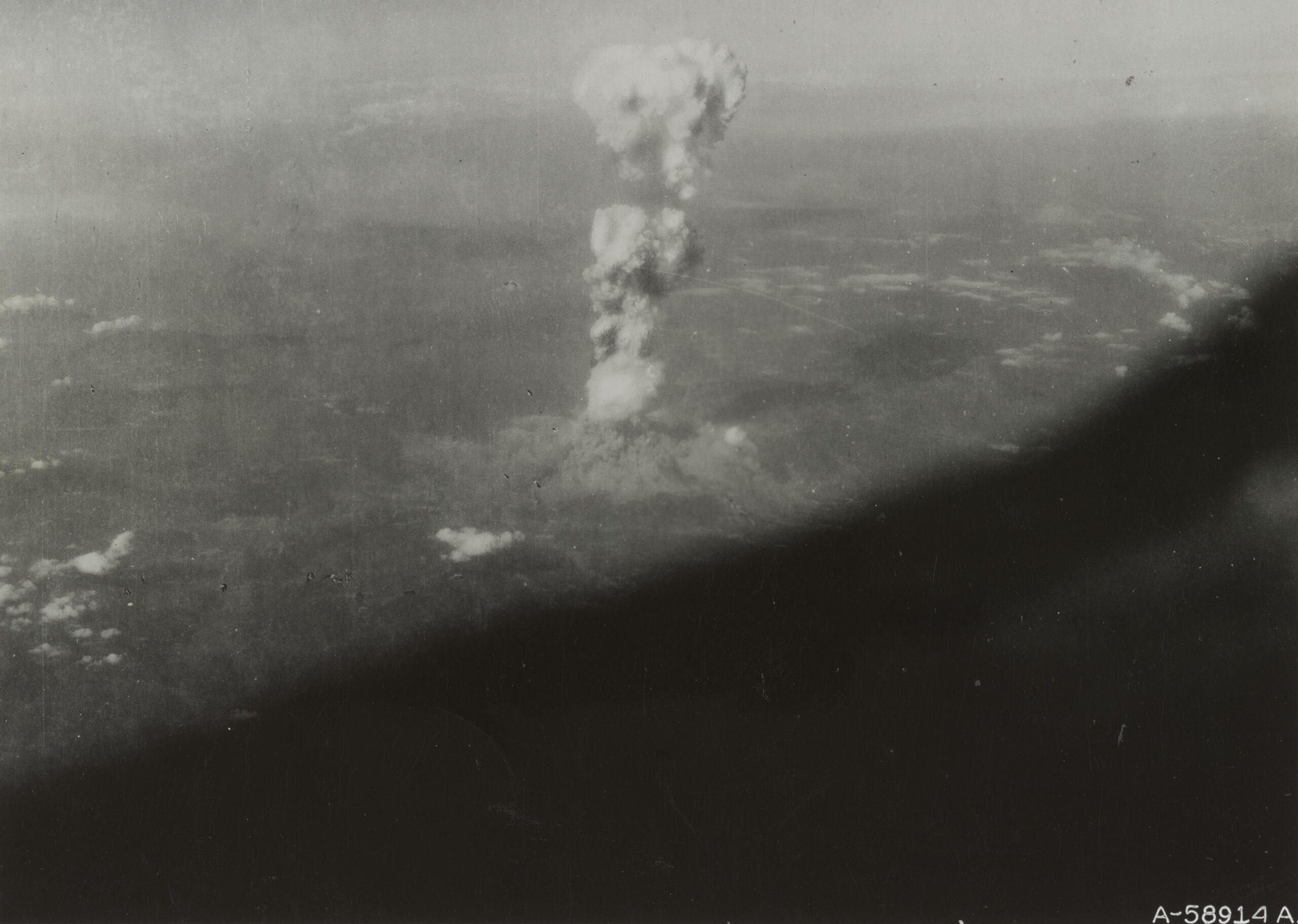
In August 1945, President Truman announced the use of the atomic bomb on Hiroshima in a radio address delivered hours after the bomb was dropped. He emphasized that “…the greatest marvel is not the size of the enterprise, its secrecy, nor its cost, but the achievement of scientific brains in putting together infinitely complex pieces of knowledge held by many men in different fields of science into a workable plan. And hardly less marvelous has been the capacity of industry to design and of labor to operate, the machines and methods to do things never done before so that the brainchild of many minds came forth in physical shape and performed as it was supposed to do.”
The decision led to not only a national debate in the months after Japan surrendered, but also an internal one at the Rockefeller Foundation (RF) because the Foundation played a role in its creation.
This debate that the Foundation grappled with is illustrated in this workshop through the perspectives of the two leaders of the RF: Raymond B. Fosdick, President of the RF from 1936-1948 and Warren Weaver, Director of the RF’s Division of Natural Sciences from 1932-1954.
Between 1938 and 1939, the Rockefeller Foundation made $80,000 in grants to the University of California to build and operate a large cyclotron under physicist Dr. Ernest O. Lawrence’s direction. The 60-inch cyclotron, completed in 1939, was the largest in the world. In 1940, the RF followed up with a subsequent $1,150,000 grant to build an even larger, 184-inch cyclotron. Dr. Lawrence directed the operation and realized that the 184-inch machine also had an important potential military application: its 4,200-ton magnet could be used to separate large quantities of uranium 235, which could be used to build an atomic bomb. He asked Warren Weaver if the Foundation would consider making an additional $60,000 grant to help speed up the construction of the magnet. But when he sought to explain his reasoning, Weaver told him not to. Weaver recalled telling Lawrence, “I know why you want it, and if you don’t tell me, then I will be in possession of no secret information and I will be under no handicaps. I think it’s quite clear that you’ve got to get the $60,000.”
Weaver relayed the details of Lawrence’s request to Fosdick. Weaver recalled, “You see, I could tell him what was afoot because nobody had told me in any official or confidential or secret terms what was afoot… I told Mr. Fosdick that I thought that some way or other we just had to give it to him. We were, however, up against the extremely curious circumstance that we couldn’t possibly explain why.” (Reminiscences of Dr. Warren Weaver, transcript of interviews conducted by Oral History Research Office, Columbia University. Volume III, 1961,” RAC, RG 13).
The RF trustees took Fosdick and Weaver at their word that the grant was essential and approved it. The magnet was completed in May 1942, and with the funding, Lawrence and his team were able to demonstrate how larger quantities of Uranium 235 could be produced. The U.S. government then took up the work and developed enough fissionable material to produce the first atomic bombs.
On August 20, 1945, shortly after the atomic bombs were dropped over Hiroshima and Nagasaki, Dr. Lawrence penned a letter to Weaver expressing his gratitude. He emphasized that the RF played a “vital part” in the bomb’s development:
It was indeed the existence of the great magnet that made it seem possible that we might be able to get somewhere on the problem [of separating enough U-235] in time to be of value in this war (Letter from Ernest O. Lawrence to Warren Weaver, August 20, 1945, RAC, RG 1.1, Series 205D).
The RF played a vital part in other ways, as well. A large number of the researchers who helped create the atomic bomb–23 in total–had received grants or fellowships from Rockefeller entities, including J. Robert Oppenheimer and Niels Bohr. Most of this support was granted in the 1920s and 1930s,when the RF was working to develop the field of theoretical physics; at the time, they could not have fathomed that it would be used to develop an atomic bomb.
Not all RF staff received the news of the RF’s contributions enthusiastically. Fosdick, in particular, was devastated and disillusioned by the wartime experience; he admitted that he felt no pride in the RF’s role in the bomb’s development, and that his “conscience was deeply troubled. Fosdick lamented that the United States had “legitimized the use of the atomic bomb as a weapon of war. We have made it respectable. . .. We have given it our moral sanction” (Letter from Raymond B. Fosdick to Warren Weaver, August 29, 1945, RAC, RG 3.2, Series 900).
Weaver, on the other hand, saw the development of the bomb as a foregone conclusion, and that it was only a matter of whether the United States or another country would develop it first. He was less certain about whether the U.S. should have used the atomic bomb. But he returned to what he described as “the practical issues”: “Did the atomic bomb shorten the war; did it save American and Japanese lives; does it constitute an irresistible compulsion for the world to organize itself into a decent and peaceful pattern? I think there is a better than even chance that the answers are all affirmative” (Letter from Warren Weaver to Raymond B. Fosdick, September 10, 1945, RAC, RG 3.2, Series 900).
Other RF staff weighed in as well. Vice President Thomas Appleget suggested that, given the Foundation’s long history of funding science throughout the world, it was perhaps inevitable that the RF would play a role in the development of the bomb. The result, however, was that “now we share in the awful responsibility for the future use of atomic energy” (Letter from Thomas B. Appleget to Raymond B. Fosdick, September 12, 1945, RAC, RG 1.1, Series 205D).
In the postwar period, the Foundation was much more cautious in its embrace of science. It turned instead to investing heavily in the social sciences and focusing on questions of postwar peace through international relations, foreign policy, and area studies programs.
In 1945, a $25,000 grant was made to a conference on the social implications of the atomic bomb. This was followed by additional grants to study American public opinion about the atomic bomb, and to study commercial atomic power.
The Division’s program officers grappled with a question succinctly posed by Fosdick in his 1945 President’s Review: “Can education and tolerance and understanding and creative intelligence run fast enough to keep us abreast with our own mounting capacity to destroy? . . . Science must help us in the answer, but the main decision lies within ourselves’ (Rockefeller Foundation Annual Report 1945, p.10).
Primary Source Workshop Summary
1.5 hours: Independent, small group, and whole group work
Raymond B. Fosdick, President of the Rockefeller Foundation, and Warren Weaver, Director of the Division of Natural Sciences for the Rockefeller Foundation, were especially invested in the discussion about the development and use of the atomic bomb. In the selected archival documents, students will read grant records, correspondence, and studies related to discussion points that include the Rockefeller Foundation’s role in the creation of the bomb, whether America should have built and used the bomb, and the impact doing so had on the future of the world.
The students will analyze the documents, engage in small group debate, and a whole-class discussion about the Rockefeller Foundation’s role in the creation of the atomic bomb and whether as a Foundation leader they would have provided the funding that contributed to the development of the atomic bomb. The students should be encouraged to cite information from the primary source documents as evidence for their stance during the debate and discussion.
Primary Source Workshop Procedure
- Students are briefed on the historical context in which the documents are to be read.
- Students are briefed on the selected primary source document guide.
- Assuming the role of the Rockefeller Foundation leaders – in particular Raymond Fosdick and Warren Weaver – students independently close read the documents and decide if the RF should have funded the work that contributed to the development of the atomic bomb. The students should be encouraged to take notes during independent close reading.
- Suggested guided questions:
- Was this internal conversation and final decision really just about science?
- What were the ethical implications?
- After independently reading the documents, the students will debate their decisions in small groups.
- Collectively, the class will discuss which decision was most necessary.
- Follow-up questions can be discussed.
Follow-Up Discussion Questions
- Describe how your close read of the archival documents was affected knowing you were looking at these primary sources through the lens of foundation leaders making these decisions.
- What were your expectations going into the workshop?
- What experiences have you had working with primary sources before this workshop?
- How did the primary sources affect your interest or investment in the workshop?
- What was most challenging when articulating your arguments for and against funding the grant that contributed to the creation of the atomic bomb?
Note to Instructor
This workshop can be adapted to an argumentative or persuasive essay format writing assignment.
Follow-Up Documents For Further Reading
- Proposed Program of Research on Public Reaction to Atomic Energy, Cornell University – Atomic Bomb, 1946-1954; Rockefeller Foundation records; Rockefeller Foundation records, Projects (Grants), RG 1; Rockefeller Foundation records, Projects, SG 1.1; Rockefeller Foundation records, projects, SG 1.1, Series 100-257, International and United States; United States, Series 200; United States – Social Sciences, Subseries 200.S; Rockefeller Archive Center (5 pages)
- Studies of Public Opinion and Attitudes Toward the Atomic Bomb, Cornell University – Atomic Bomb, 1946-1954; Rockefeller Foundation records; Rockefeller Foundation records, Projects (Grants), RG 1; Rockefeller Foundation records, Projects, SG 1.1; Rockefeller Foundation records, projects, SG 1.1, Series 100-257, International and United States; United States, Series 200; United States – Social Sciences, Subseries 200.S; Rockefeller Archive Center (6 pages)
Primary Source Document Guide
The Atom Smashers Score a Hit (4 pages)
1939
Trustees Bulletins | Rockefeller Foundation records | Rockefeller Archive Center
Letter from Ernest O. Lawrence to Warren Weaver (4 pages)
October 14, 1937
Natural Sciences and Agriculture – Subseries 205. D | California – Series 205 | Projects (Grants) – Record Group 1.1 | Rockefeller Foundation records | Rockefeller Archive Center
Letter from Warren Weaver to Karl T. Compton (3 pages)
March 1, 1940
Natural Sciences and Agriculture – Subseries 205. D | California – Series 205 | Projects (Grants) – Record Group 1.1 | Rockefeller Foundation records | Rockefeller Archive Center
Cyclotron Grant (2 pages)
January 16, 1942
Natural Sciences and Agriculture – Subseries 205. D | California – Series 205 | Projects (Grants) – Record Group 1.1 | Rockefeller Foundation records | Rockefeller Archive Center
Grant from the Foundation to Cornell University – Atomic Energy and the Citizen (7 pages)
1948
Social Sciences – Subseries 205.S | United States – Series 200 | Projects (Grants) – Record Group 1.1 | Rockefeller Foundation records | Rockefeller Archive Center
Letter from Raymond B. Fosdick to Warren Weaver (4 pages)
August 29, 1945
General Program and Policy – Series 900 | Administration, Program, and Policy – Record Group 3.2 | Rockefeller Foundation records | Rockefeller Archive Center
Letter from David H. Stevens to Raymond B. Fosdick (1 page)
August 30, 1945
General Program and Policy – Series 900 | Administration, Program, and Policy – Record Group 3.2 | Rockefeller Foundation records | Rockefeller Archive Center
Letter from David H. Stevens to Raymond B. Fosdick (5 pages)
September 10, 1945
General Program and Policy – Series 900 | Administration, Program, and Policy – Record Group 3.2 | Rockefeller Foundation records | Rockefeller Archive Center
Letter from Ernest O. Lawrence to Raymond B. Fosdick (1 page)
September 10, 1945
Natural Sciences and Agriculture – Subseries 205. D | California – Series 205 | Projects (Grants) – Record Group 1.1 | Rockefeller Foundation records | Rockefeller Archive Center